18 October 2026
 Thursday, 24th September 2026
 Hilton Abu Dhabi, Yas Island, UAE
Event Date
Thursday, 24th September 2026
Event Location
Hilton Abu Dhabi, Yas Island, UAE
7 July 2026
Global transport decarbonisation is entering a phase where policy ambition is no longer the limiting factor. Governments, regulators, and international bodies have already established a broad framework of climate targets, emissions reduction pathways, and regulatory mechanisms. The defining challenge now is implementation.
Across shipping, ports are emerging as the critical interface between climate policy and operational reality. They are where regulatory requirements are translated into fuel infrastructure, energy systems, and compliance mechanisms. As such, ports are becoming central to whether global transport decarbonisation accelerates or stalls.
Policy Foundations Are Largely in Place
Over the past decade, the policy landscape for transport decarbonisation has expanded significantly. The International Maritime Organization has committed to net zero greenhouse gas emissions “by or around 2050,” supported by interim checkpoints expected in the 2030s. This provides a global directional framework, although enforcement mechanisms remain under development.
At the regional level, regulatory systems are already more advanced. The European Union Emissions Trading System now includes maritime emissions, effectively placing a carbon price on shipping operations linked to European ports. FuelEU Maritime further introduces lifecycle fuel intensity requirements, shifting focus from tailpipe emissions to full fuel-chain emissions.
Together, these measures are reshaping commercial decision making in shipping, influencing chartering patterns, fuel procurement strategies, and long-term fleet investment planning.
However, policy alignment is not uniform globally. While some regions are moving toward strict enforcement mechanisms, others are still developing regulatory frameworks or prioritising gradual transition pathways. This divergence creates operational complexity for international shipping companies.
Ports as Transition Infrastructure Hubs
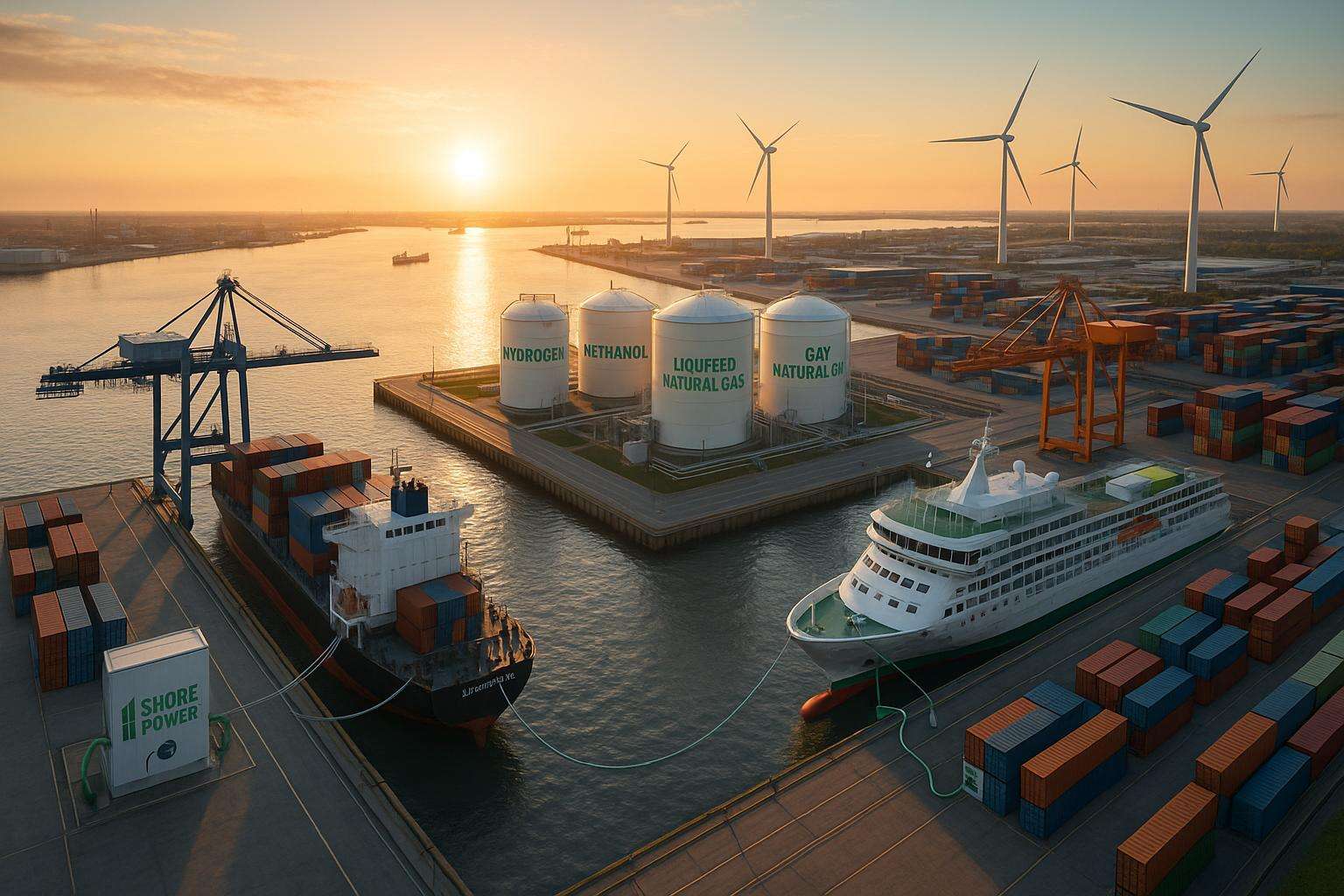
Ports are increasingly being repositioned from traditional logistics nodes to integrated energy transition hubs. This shift reflects the need to support alternative fuels, electrification systems, and emissions monitoring infrastructure at scale.
Modern port transformation now includes several key dimensions:
According to the International Association of Ports and Harbors, leading global ports are now allocating significant portions of capital expenditure toward sustainability-related infrastructure, although levels of investment vary widely across regions.
The Infrastructure Gap Problem
Despite progress in leading hubs, the global port system remains highly uneven in its readiness for decarbonised operations.
Advanced ports in Europe and parts of Asia are moving toward integrated energy systems, while many emerging market ports face structural constraints related to financing, technology access, and institutional capacity.
This unevenness creates a bottleneck effect across global trade networks. Even if ships are capable of operating on low-carbon fuels, the lack of consistent port infrastructure limits the feasibility of full-scale deployment.
As a result, decarbonisation is progressing in clusters rather than uniformly across global shipping routes.
Capital Investment and Execution Risk
One of the central challenges in port transformation is capital mobilisation. Infrastructure upgrades require significant upfront investment, often with uncertain revenue recovery models.
Public-private partnerships are increasingly being used to bridge this gap. Multilateral development banks and climate finance institutions are also playing a growing role in de-risking early-stage infrastructure investment.
However, execution risk remains high. Factors such as regulatory uncertainty, demand volatility for alternative fuels, and evolving technology standards all affect investment confidence.
This creates a gap between policy intent and implementation capacity, particularly in regions where institutional frameworks for large-scale infrastructure delivery are still developing.
The Role of Standardisation and Coordination
Implementation is further complicated by the lack of global standardisation in fuel systems, safety protocols, and infrastructure design. Unlike conventional fuels, alternative fuels such as ammonia and hydrogen require new safety frameworks and handling standards.
Without harmonised global standards, ports risk developing incompatible systems, which could increase costs and reduce interoperability across global shipping networks.
International coordination through organisations such as the IMO and industry classification societies is therefore becoming increasingly important to ensure consistency in infrastructure development.
Execution as the Defining Constraint
The transition from policy to implementation is now the defining constraint in global transport decarbonisation. While regulatory frameworks are largely in place, the ability to translate these frameworks into operational infrastructure remains uneven.
Ports sit at the centre of this challenge. They are not only logistics gateways but also critical energy transition platforms. Their ability to scale infrastructure, attract investment, and coordinate with shipping operators will determine the pace of global progress.
In this context, the next phase of climate action is no longer about setting new policy targets. It is about building the systems required to implement the ones already established.