Event Date

Thursday, 24th September 2026

Event Location

Hilton Abu Dhabi, Yas Island, UAE
2 September 2026

The Climate Risk Premium: How Physical Climate Risk Is Changing Transport Infrastructure Investment

The Climate Risk Premium: How Physical Climate Risk Is Changing Transport Infrastructure Investment

For much of the transport industry, climate change has traditionally been framed as a question of emissions.

How quickly can ships reduce fuel consumption? How can airports increase sustainable aviation fuel use? How can road transport electrify? How can ports reduce their carbon footprint?

Those questions remain central.

But another climate challenge is becoming increasingly difficult to ignore.

The infrastructure itself is exposed to a changing physical environment.

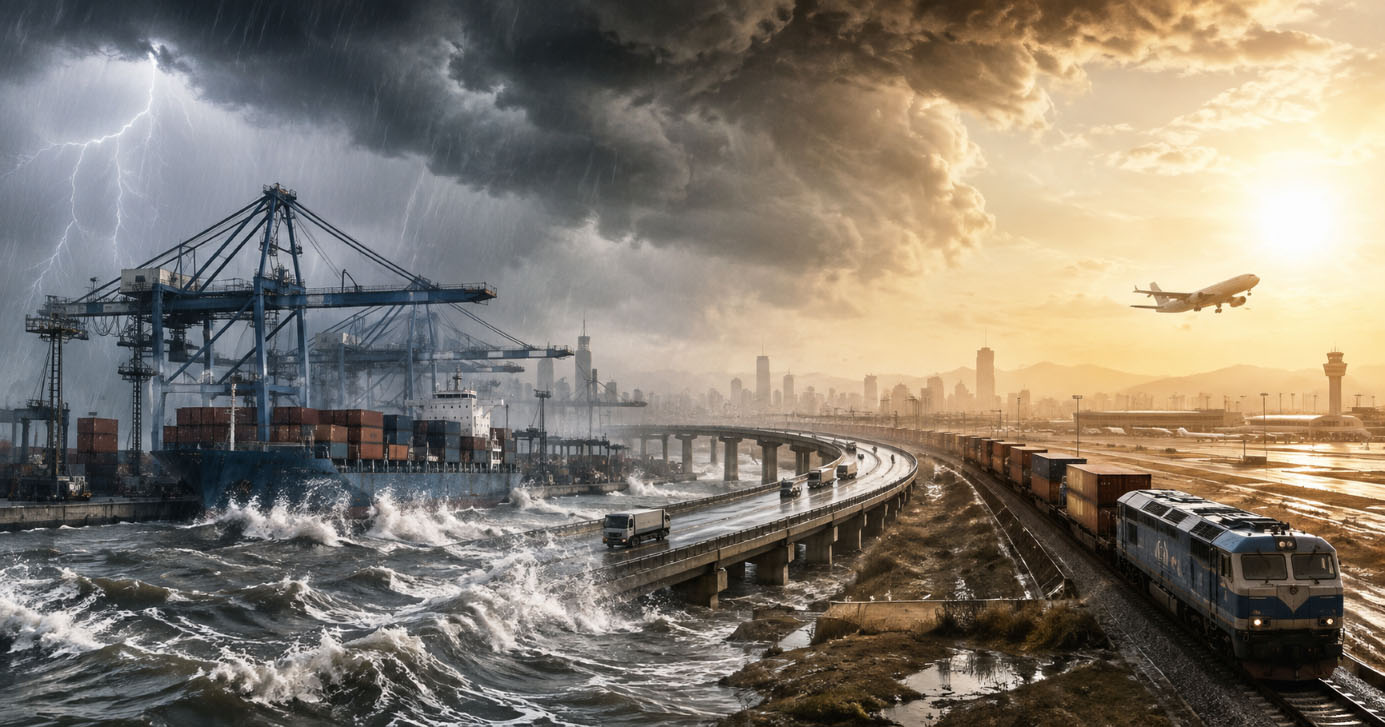
Roads can be damaged by floods. Rail infrastructure can be disrupted by extreme heat. Ports and coastal infrastructure face rising exposure to storms and sea-level-related risks. Airports can face heat-related operational constraints. Drought can affect inland waterways and logistics networks.

This changes the economics of transport infrastructure.

An asset that was considered adequately designed for historical climate conditions may no longer provide the same level of reliability over its expected operating life.

For investors and governments, the implication is increasingly clear: climate resilience must become part of the core investment decision.

Climate Risk Is Becoming an Asset-Management Issue

Transport infrastructure is designed to last.

A road, bridge, railway, port or airport can remain operational for several decades. Investment decisions made today therefore need to account for climate conditions that may be very different from those experienced historically.

The OECD's 2026 analysis of transport infrastructure in Mongolia makes this point directly. It warns that intensifying risks such as floods and droughts make climate-resilient planning essential to avoid locking in long-term vulnerabilities and future costs.

This principle applies far beyond Mongolia.

The longer an asset remains in service, the greater the importance of understanding how its operating environment may change.

Extreme Heat Is an Increasing Transport Challenge

Heat is one example of a risk that can affect multiple transport modes.

The International Transport Forum reported in July 2026 that increasingly frequent and intense heatwaves are disrupting public transport, damaging infrastructure and creating safety risks for passengers and workers. Extreme heat can buckle railway tracks, place pressure on power and cooling systems and create difficult operating conditions for buses and trains.

These impacts can have wider economic consequences.

A transport disruption does not stop at the infrastructure itself.

If a railway is closed, workers may not reach workplaces and freight may be delayed. If a road is damaged, supply chains can be interrupted. If port operations are constrained, cargo movements can be delayed across entire trade corridors.

The economic cost of climate risk therefore extends well beyond the repair bill.

Designing for Historical Climate Conditions Is No Longer Enough

Traditional infrastructure design often relies heavily on historical climate and weather data.

But if the underlying climate is changing, historical averages become a less reliable basis for future investment.

This creates a challenge for engineers and planners.

Infrastructure must increasingly be designed around projected ranges of future conditions rather than assuming that the past will provide an adequate guide to the future.

The OECD's 2026 work recommends strengthening climate-risk integration into transport infrastructure planning and design, including stronger use of climate-risk data and asset-level assessments.

This represents a shift from reactive adaptation to anticipatory planning.

Instead of rebuilding an asset after a climate-related failure, the objective is to reduce the probability and severity of that failure from the beginning.

Resilience Has a Capital Cost

Climate-resilient infrastructure is rarely cost-free.

Higher-quality materials, improved drainage, stronger foundations, elevated infrastructure, flood protection and additional monitoring systems can increase initial construction costs.

This can create a difficult decision for governments and investors.

Should a project prioritise the lowest possible upfront cost, or should it spend more today to reduce potential future losses?

Increasingly, the answer is moving towards the second approach.

The World Bank argues that modern resilient transport infrastructure can reduce the need for repeated reconstruction while strengthening connectivity and supply-chain reliability. Its global transport portfolio stood at nearly $45 billion at the end of February 2026, with all World Bank transport projects approved in FY2025 incorporating climate co-benefits.

The underlying principle is straightforward.

The cheapest asset to build is not necessarily the cheapest asset to own.

The Cost of Disruption Matters

Investment decisions often focus on construction and maintenance costs.

But climate risk adds another variable: disruption.

A transport asset can remain physically intact but still become economically impaired if extreme weather repeatedly reduces its capacity or reliability.

For logistics operators, reliability is itself a commercial asset.

A shipping line needs confidence that a port will remain operational. A freight operator needs reliable road and rail connections. A manufacturer depends on predictable delivery schedules.

This means climate resilience can have value even when extreme weather does not cause catastrophic physical damage.

A more resilient transport corridor can provide greater reliability to the businesses that depend on it.

Ports Face a Particularly Complex Risk Profile

Ports illustrate the intersection between physical climate risk and long-term investment.

Many major ports are located in coastal areas and are exposed to combinations of flooding, storms, extreme heat and changing sea conditions.

At the same time, ports are becoming more important to the energy transition.

They are expected to accommodate shore power, alternative fuel bunkering, energy storage, electrification and new logistics systems.

This means port investment decisions increasingly need to consider two dimensions simultaneously:

How can the port reduce emissions?

and

How can the port continue operating as climate risks increase?

The answers cannot be developed independently.

A new alternative-fuel terminal that is not sufficiently resilient to future climate conditions could become a stranded or underperforming asset.

Climate Risk Is Entering the Financing Equation

The growing importance of physical climate risk is also changing the role of finance.

Investors increasingly need to assess not only whether a transport project can generate sufficient returns, but also whether those returns are vulnerable to physical climate disruption.

This could influence:

  • Project financing
  • Insurance premiums
  • Loan conditions
  • Asset valuations
  • Infrastructure concession agreements
  • Public-sector investment priorities

Climate adaptation therefore has the potential to become a financial risk-management issue.

The OECD's 2026 work on sustainable infrastructure investment emphasises the importance of better project assessment and financing approaches that account for broader economic, environmental and resilience outcomes.

Insurance Could Become an Important Signal

Insurance markets provide another indication of how physical climate risk is changing.

When the probability of extreme events increases, insurance costs and availability can become important considerations for infrastructure owners.

This creates a potential feedback mechanism.

An asset that is demonstrably resilient may be easier to insure and finance than one with significant unresolved exposure.

Over time, resilience could therefore become an increasingly visible component of the total cost of ownership.

Developing Economies Face a Particular Challenge

The issue is especially important in emerging markets.

Many developing countries need to expand transport infrastructure rapidly to support economic growth, trade and urbanisation.

At the same time, they may face higher exposure to climate hazards and more limited access to capital.

This creates a difficult investment equation.

Infrastructure needs to be expanded without creating assets that are vulnerable to future climate conditions.

Recent World Bank financing for the Djibouti-Addis corridor illustrates how resilience is increasingly being incorporated directly into transport investment. The project includes stronger drainage systems, resilient pavement structures and measures designed to withstand extreme heat and intense rainfall.

This approach demonstrates how adaptation can be integrated into conventional transport development rather than treated as a separate climate programme.

Nature-Based Solutions Are Part of the Toolkit

Not every resilience solution needs to be engineered in concrete and steel.

Nature-based approaches can complement conventional infrastructure.

Wetlands can help absorb floodwater. Vegetation can reduce heat exposure. Natural coastal systems can provide protection against some forms of storm impact.

The OECD and World Bank increasingly recognise nature-based solutions as part of the broader sustainable and resilient infrastructure toolkit.

For transport planners, this creates another opportunity to think beyond individual assets and consider the wider ecosystem in which infrastructure operates.

The Shift From Repair to Prevention

The most important change may ultimately be institutional.

Transport agencies have traditionally focused heavily on maintaining infrastructure based on observed deterioration.

Climate change requires a more forward-looking approach.

Asset managers increasingly need to ask:

  • What climate risks could affect this asset over its lifetime?
  • How frequently could those risks occur?
  • What would disruption cost?
  • Which adaptation measures are economically justified?
  • Can the asset be upgraded progressively as conditions change?

This approach allows resilience investment to become part of normal asset management rather than an emergency response.

Building Adaptable Infrastructure

There is also a case for designing infrastructure that can be modified over time.

Climate projections contain uncertainty.

Rather than attempting to predict exactly what conditions will exist several decades from now, infrastructure planners can develop flexible adaptation pathways.

An asset might initially be built to one standard but designed so that additional protection can be added later if risk increases.

This can reduce the danger of either under-investing today or spending unnecessarily on measures that may not become necessary for many years.

The New Infrastructure Equation

Transport infrastructure investment is therefore becoming a three-part equation:

Efficiency + Decarbonisation + Resilience

An asset that is low-carbon but vulnerable to extreme weather is not necessarily a sustainable asset.

Similarly, infrastructure that is highly resilient but locks in decades of high emissions may create another form of long-term risk.

The objective is increasingly to build assets that can remain economically viable, operationally reliable and environmentally compatible throughout their full lifecycle.

Climate change is changing what transport infrastructure needs to achieve.

It is no longer sufficient for roads, railways, ports and airports to be efficient and economically productive. They must also be capable of operating under increasingly challenging physical conditions.

That means climate adaptation needs to move further into mainstream infrastructure planning, engineering, finance and asset management.

The investment decision is shifting from:

"How much will this infrastructure cost to build?"

towards:

"What will it cost if this infrastructure is not resilient enough?"

That is a significant change in the economics of transport.

As governments and investors plan infrastructure that will operate for decades, physical climate risk will increasingly influence where capital goes, how assets are designed and how their long-term value is assessed.

The next generation of transport infrastructure will therefore need to achieve more than lower emissions.

It will need to withstand the climate in which it will actually operate.

AD Ports Group
Platinum Sponsor
Adnoc Logistics & Services
Gold Sponsor
Drydocks World
Gold Sponsor
Noatum Logistics
Main Session
Saifee Ship Spare Parts & Ship Chandlers L.L.C
Delegate Lunch
ASYAD Shipping
Lanyards and Badges
SOHAR Port & Freezone
Delegate Bags
JOME Engineering LLC
Conference Registration
IRI/The Marshal Island Registry
Session 2
J M Baxi
Multimedia Sponsor
Islamic P & I
Notepads and Pens
Monjasa
Water Bottles & Mints
Noatum CSM
General Sponsor
TMC Shipping
General Sponsor
Al Safina Security Services (ALSS)
General Sponsor
StormGeo
General Sponsor
DNV
General Sponsor
J M Baxi
Multimedia Sponsor
Islamic P & I
Notepads and Pens
Monjasa
Water Bottles & Mints
Noatum CSM
General Sponsor
TMC Shipping
General Sponsor
Al Safina Security Services (ALSS)
General Sponsor
StormGeo
General Sponsor
DNV
General Sponsor
J M Baxi
Multimedia Sponsor
Islamic P & I
Notepads and Pens
Monjasa
Water Bottles & Mints
Noatum CSM
General Sponsor
TMC Shipping
General Sponsor
Al Safina Security Services (ALSS)
General Sponsor
StormGeo
General Sponsor
DNV
General Sponsor
J M Baxi
Multimedia Sponsor
Islamic P & I
Notepads and Pens
Monjasa
Water Bottles & Mints
Noatum CSM
General Sponsor
TMC Shipping
General Sponsor
Al Safina Security Services (ALSS)
General Sponsor
StormGeo
General Sponsor
DNV
General Sponsor
J M Baxi
Multimedia Sponsor
Islamic P & I
Notepads and Pens
Monjasa
Water Bottles & Mints
Noatum CSM
General Sponsor
TMC Shipping
General Sponsor
Al Safina Security Services (ALSS)
General Sponsor
StormGeo
General Sponsor
DNV
General Sponsor
J M Baxi
Multimedia Sponsor
Islamic P & I
Notepads and Pens
Monjasa
Water Bottles & Mints
Noatum CSM
General Sponsor
TMC Shipping
General Sponsor
Al Safina Security Services (ALSS)
General Sponsor
StormGeo
General Sponsor
DNV
General Sponsor

Supporting Associations

Ceylon Association of Shipping Agents (CASA)
Conqueror Freight Network
Dubai Council for Marine & Maritime Industries (DCMMI Emirates)
Emirates Shipping Association (UAE Shipping Association)
Globalia Logistics Network
Supply Chain & Logistics Group
The Cooperative Logistics Network
YoungShip Srilanka
Institute of Marine Engineering, Science and Technology (IMarEST)
International Ship Engineering Service Association
Maritime SheEO
Asian Shipowners’ Association
Institute of Chartered Shipbrokers, Middle East Branch
International Marine Purchasing Association (IMPA)
All India Association of Industries
ASIAN SHIPOWNERS’ ASSOCIATION
Energy Industries Council
International Bunker Industry Association
INTERNATIONAL SHIPSUPPLIES & SERVICES ASSOCIATION
Mission to Seafarers
Nautical Institute
UAE National Ship Suppliers Association
WISTA
WISTA UAE

Media Partners

Cleaner Seas
Conference Locate (Clocate)
Cyprus Shipping News
Devdiscourse
ExpoTobi Co Ltd.

India Shipping News
International Bulk Journal (IBJ) - Glenbuck Publishing Ltd
International Freight Network
Marine Bunker Exchange
MaritimAfrica
Nautic Magazine
Petrofinder
Ship2Shore
Specialist Freight Network
Tank News International
TradeMaker
World Freight Network
WorldMaritimeEvents.Com (Nautic Vision BV)
Worldoils
Cleaner Seas
Conference Locate (Clocate)
Cyprus Shipping News
Devdiscourse
ExpoTobi Co Ltd.
India Shipping News
International Bulk Journal (IBJ) - Glenbuck Publishing Ltd
International Freight Network
Marine Bunker Exchange
MaritimAfrica
Nautic Magazine
Petrofinder
Ship2Shore
Specialist Freight Network
Tank News International
TradeMaker
World Freight Network
WorldMaritimeEvents.Com (Nautic Vision BV)
Worldoils