
11 October 2026
 Thursday, 24th September 2026
 Hilton Abu Dhabi, Yas Island, UAE


Event Date
Thursday, 24th September 2026
Event Location
Hilton Abu Dhabi, Yas Island, UAE
19 October 2026
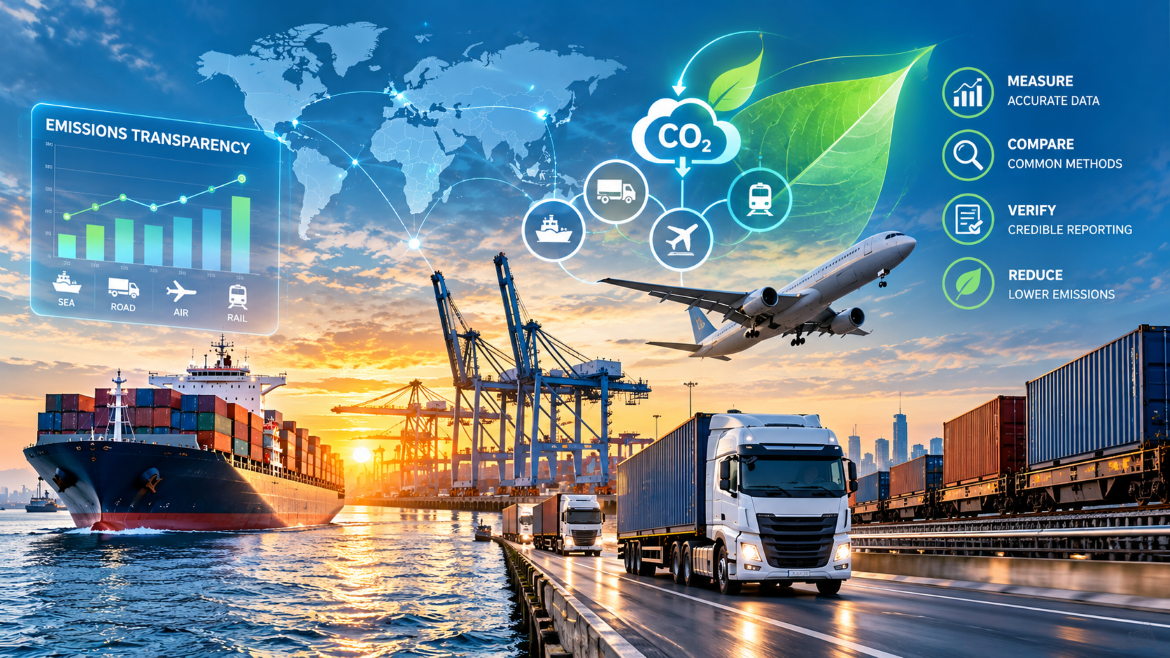
Beyond the Numbers: Why Emissions Transparency Is Reshaping Transport
For years, transport companies have communicated their environmental ambitions through emissions targets, sustainability commitments and plans to adopt cleaner technologies. Increasingly, however, stakeholders want more than statements of intent. They want evidence.
How much carbon does a shipment generate? How are emissions calculated across different transport modes? Can customers compare the environmental performance of competing logistics providers? And how can a company demonstrate that its emissions are falling rather than simply reporting new targets?
These questions are changing the relationship between transport businesses and their customers, investors and regulators. Emissions transparency is emerging as an important part of the industry's transition.
It connects environmental performance with commercial decisions, making the quality of emissions information increasingly relevant to procurement, reporting and business strategy. The challenge is no longer simply to measure emissions. It is to make the information consistent, credible and useful for decision-making.
Why emissions reporting matters more
Transport emissions rarely sit neatly within the boundaries of a single company. A manufacturer may rely on shipping, road freight, aviation and warehousing to deliver products. A retailer may outsource almost its entire logistics operation.
A freight forwarder may coordinate several carriers across multiple countries, each using different equipment, fuels and calculation methods. Consequently, a company's reported climate footprint can depend heavily on the transport services it purchases, and the methods used to calculate their emissions.
The Greenhouse Gas Protocol's Scope 3 Standard provides a framework for accounting for indirect emissions across a company's value chain, including relevant transportation and distribution activities. These emissions can be significant even when they occur outside the reporting company's direct operations.
This creates a practical challenge for transport providers. Their customers increasingly need emissions information that can be incorporated into corporate inventories, sustainability disclosures and purchasing decisions. For carriers and logistics operators, the ability to supply reliable information could therefore become an important element of customer service.
From different calculations to comparable results
One persistent obstacle is inconsistency. Two logistics providers may report different emissions for similar services because they use different assumptions about fuel consumption, vehicle utilisation, cargo weight, distance, empty journeys or the allocation of emissions between customers.
Even where both calculations are technically defensible, the results may not be directly comparable. This can make it difficult for businesses to identify the most effective transport options or determine whether an apparent improvement reflects genuine operational progress.
A significant development came on 1 June 2026, when the European Union's CountEmissionsEU framework entered into force. It establishes a common methodology for calculating greenhouse gas emissions from freight and passenger transport, aligned with the international standard EN ISO 14083:2023.
The framework is intended to improve the accuracy and comparability of transport emissions information, supporting business decisions, low-emission procurement and clearer reporting.
Its application is voluntary for organisations disclosing transport emissions under the framework, with further implementation measures expected as the system develops. The direction is important beyond Europe.
As supply chains cross borders, common calculation methods can help reduce the inconsistencies that arise when different markets and service providers use incompatible approaches.
Shipping demonstrates the growing importance of verification Maritime transport illustrates how emissions reporting is becoming connected to operational and regulatory requirements.
The International Maritime Organization's Data Collection System requires ships of 5,000 gross tonnage and above to collect and report specified fuel-consumption data. These vessels account for approximately 85% of carbon dioxide emissions from international shipping, according to the IMO.
The data also supports the calculation of operational carbon intensity under the IMO's existing framework. In the European market, shipping companies face additional monitoring, reporting and verification requirements under the EU's maritime emissions framework.
The extension of the EU Emissions Trading System to maritime transport from 2024 has further connected verified emissions data with compliance obligations and carbon costs.
These developments show that emissions information is no longer only a sustainability reporting exercise. It can affect regulatory compliance, operating costs and the assessment of vessel performance. For shipowners, accurate records and consistent methodologies are increasingly important to understanding emissions exposure and demonstrating performance to customers and authorities.
The commercial value of transparency
Reliable emissions data can help transport companies make better commercial decisions. A logistics operator that understands emissions by route, vehicle type, load factor and fuel consumption can identify where operational improvements may deliver both environmental and economic benefits.
Customers can use comparable information to assess transport options, evaluate suppliers and incorporate emissions considerations into procurement. For example, a shipper comparing two freight services needs more than a general claim that one is greener.
It needs to understand the emissions boundary, the calculation methodology, the assumptions used and whether the figures reflect actual operations or standard estimates. This does not mean emissions should become the only criterion in purchasing decisions.
Cost, reliability, transit time, safety and service quality remain important. But better information allows businesses to assess these factors alongside environmental performance rather than relying on broad claims that are difficult to verify. Over time, emissions transparency could become a differentiator for transport providers that can demonstrate measurable improvements and explain how those results were achieved.
The challenge of measuring complex supply chains
Achieving meaningful transparency is not straightforward. Transport services often involve several carriers, different modes and multiple handling points. Data may be incomplete, particularly where smaller operators lack sophisticated reporting systems or where subcontractors do not provide consistent information.
Companies may also face difficulties distinguishing measured emissions from estimates. These limitations matter because the appearance of precision does not necessarily guarantee accuracy. A detailed emissions figure based on weak assumptions can be less useful than a transparent estimate with clearly stated limitations.
Businesses therefore need to document their methodologies, disclose material assumptions and improve the quality of underlying data over time. Standardisation can help, but it does not remove the need for reliable source information and independent verification where required.
The objective should be credible reporting, not simply more reporting.
Transparency must lead to reductions
There is a risk that emissions reporting becomes an administrative exercise, with companies concentrating on producing disclosures rather than improving performance. Measurement alone does not reduce emissions.
Its value lies in identifying where emissions originate, establishing a baseline and evaluating whether interventions are working. Companies can then use that information to assess route efficiency, improve vehicle utilisation, reduce unnecessary journeys, select lower-emission transport options and evaluate investments in cleaner technologies.
Consistent reporting also makes it easier to track progress over time, provided that changes in methodology, business activity and reporting boundaries are properly explained. This is where transparency becomes an operational tool rather than a communications function.
It gives businesses a stronger basis for prioritising action and helps customers distinguish between commitments and demonstrated results.
A new expectation for transport businesses
The growing emphasis on emissions transparency signals a broader change in how environmental performance is assessed. Targets remain important, but they are only the starting point. Businesses increasingly need to explain what is being measured, how calculations are made, where uncertainty remains and what actions are producing results.
For transport operators, this creates both a responsibility and an opportunity. Companies that invest in credible reporting can improve internal decision-making, respond more effectively to customer requirements and demonstrate the value of operational improvements.
For the wider industry, consistent emissions information can help create a more informed market in which environmental performance is assessed on a clearer basis.
The next stage of transport decarbonisation will depend not only on reducing emissions, but also on demonstrating those reductions credibly.
As reporting methods improve and expectations evolve, transparency could become a defining feature of competitive, accountable and sustainable transport.