18 October 2026
 Thursday, 24th September 2026
 Hilton Abu Dhabi, Yas Island, UAE

Event Date
Thursday, 24th September 2026
Event Location
Hilton Abu Dhabi, Yas Island, UAE
26 October 2026
Beyond CO₂: Why Transport Must Address Methane and Other Climate Pollutants
Carbon dioxide has become the central measure of transport's climate impact, shaping emissions targets, investment decisions, fuel strategies and regulatory frameworks. Its importance is clear: CO₂ accumulates in the atmosphere and contributes to long-term warming. Yet a focus on carbon alone can leave important parts of transport's climate footprint insufficiently addressed.
Methane, nitrous oxide, nitrogen oxides, soot and other emissions can influence the climate through different mechanisms and over different timescales. Aviation also produces contrails and changes in high-altitude cloud formation, with effects that depend on atmospheric conditions. These impacts are not interchangeable, and their relative importance varies across transport modes.
For an industry pursuing net zero, the implication is significant. Progress cannot be assessed through a single emissions measure if that measure does not capture the full range of relevant climate effects. Transport needs a more comprehensive approach that complements CO₂ reduction with targeted action on other pollutants.
Shipping's methane challenge
The expansion of liquefied natural gas (LNG) as a marine fuel illustrates the complexity of the transition. LNG combustion can produce less CO₂ than conventional oil-based marine fuels, making it an option for reducing certain emissions from ships. However, its climate performance also depends on methane released during fuel production, processing, transport and use.
Methane is a potent greenhouse gas with a shorter atmospheric lifetime than CO₂. Reducing its emissions can therefore deliver important near-term climate benefits, while also limiting its contribution to ground-level ozone formation.
In shipping, one concern is methane slip, which occurs when some of the gas passes through an engine without being fully combusted. The amount released varies according to engine design, operating conditions and technology. Methane can also escape elsewhere in the LNG supply chain, including during handling and transport.
This does not mean LNG has the same climate profile in every application, or that its benefits should be dismissed. It means that fuel choices need to be evaluated across the full supply chain rather than on exhaust CO₂ alone.
For shipowners, charterers and fuel suppliers, this creates a practical requirement: understand the emissions associated with a fuel from production to consumption. Engine selection, maintenance, operational performance and effective methane management can all influence the outcome. Regulators and investors will also need better information to distinguish between fuels that deliver genuine lifecycle improvements and those whose benefits are less substantial than headline figures suggest.
Aviation's climate impact extends beyond exhaust CO₂
Aviation faces a different challenge. Aircraft emit CO₂ through fuel combustion, but their climate impact also includes non-CO₂ effects associated with nitrogen oxides, water vapour, particles and contrails.
Contrails form when aircraft exhaust interacts with cold, humid atmospheric conditions. Under certain circumstances, the resulting ice-crystal clouds persist and develop into contrail cirrus, which can trap outgoing heat. Their climate effect varies according to location, altitude, weather and time of day.
Nitrogen oxides also affect atmospheric chemistry. They contribute to the formation of ozone, which warms the climate, while also influencing methane concentrations. The combined effects are complex and cannot be represented accurately by treating every emission as equivalent to CO₂.
This creates a measurement and operational challenge. CO₂ emissions can be estimated from fuel consumption with established methods, but the climate effect of individual flights can depend on atmospheric conditions and flight paths. Scientific understanding is improving, although important uncertainties remain.
Potential responses include improved weather forecasting, better flight planning and adjustments to altitude or routing where these can reduce the likelihood of persistent warming contrails. Such measures must also account for fuel consumption, flight safety, air traffic constraints and operational costs.
Sustainable aviation fuels can help reduce lifecycle greenhouse gas emissions, depending on how they are produced. However, their use does not automatically eliminate every non-CO₂ effect of flying. Fuel transition and operational measures therefore need to be considered as complementary approaches.
Road transport and the wider pollution burden
On roads, climate policy and air-quality policy frequently intersect. Diesel engines and other combustion sources can release nitrogen oxides and particulate matter alongside greenhouse gases. Black carbon, a component of soot, absorbs sunlight and contributes to warming, while also affecting air quality and human health.
The effects differ from those of CO₂. Carbon dioxide is a long-lived greenhouse gas that drives cumulative warming. Some other pollutants have shorter atmospheric lifetimes but can cause substantial regional or near-term impacts.
Electrification can eliminate exhaust emissions from vehicles at the point of use, including tailpipe CO₂, nitrogen oxides and combustion-related particulate matter. Its overall climate benefit depends partly on electricity generation, vehicle manufacturing and battery supply chains. Electric vehicles also continue to produce non-exhaust particles from tyres, road surfaces and, in some cases, brakes.
For heavy road freight, the pace of fleet renewal, charging infrastructure and vehicle utilisation will influence how quickly emissions decline. Cleaner vehicles remain important, but reducing unnecessary vehicle movements, improving logistics efficiency and shifting suitable freight to lower-emission modes can complement technological change.
The wider lesson is that transport policy should distinguish between climate mitigation and local air-quality improvement while recognising where their benefits overlap. A measure that reduces one pollutant does not necessarily reduce all others.
Better measurement, more targeted action
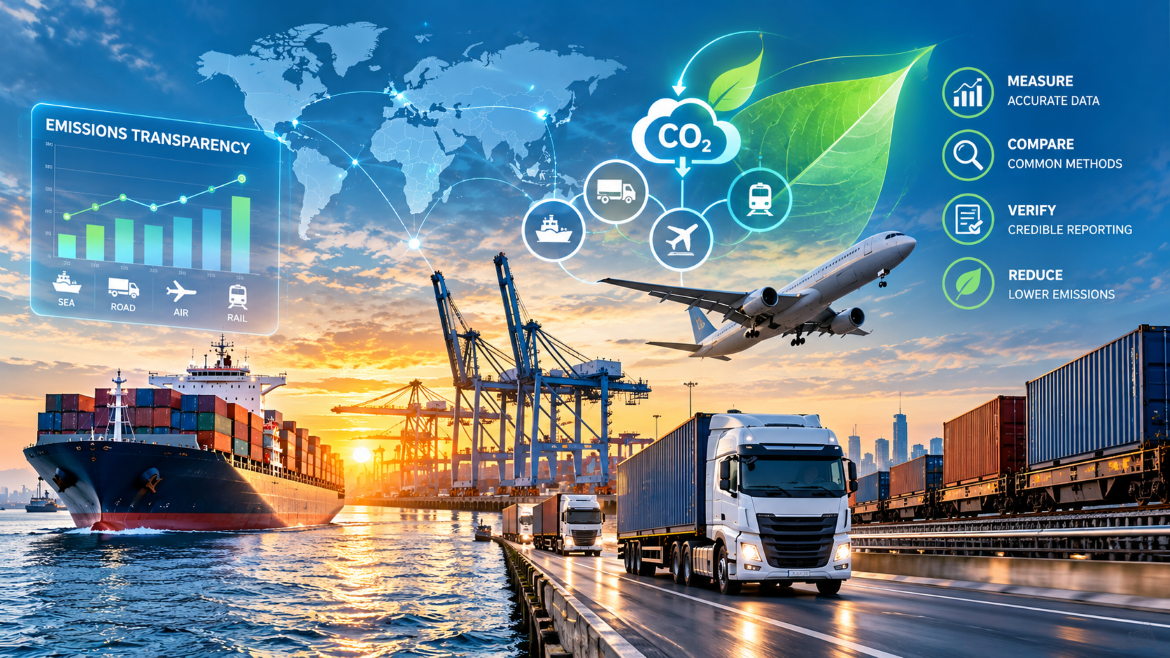
A broader approach to transport emissions requires more than adding new indicators to corporate sustainability reports. It calls for measurement systems that reflect the characteristics of each transport mode and support decisions that can reduce emissions in practice.
For shipping, this means improving the assessment of methane slip and lifecycle fuel emissions. For aviation, it means strengthening research, monitoring and operational methods for non-CO₂ effects. For road transport, it means evaluating greenhouse gases alongside pollutants that affect local air quality, without confusing their different impacts.
Comparisons also need clear boundaries. Lifecycle emissions, direct exhaust emissions and total climate effects measure different things. Converting every pollutant into a single carbon-dioxide-equivalent figure can be useful, but results depend on the assessment period, methodology and assumptions applied. In aviation, some non-CO₂ effects cannot yet be represented with the same confidence as direct CO₂ emissions.
Regulation and investment frameworks must reflect these distinctions. Standardised methods can improve consistency, while transparent assumptions and better monitoring can help companies make informed choices. Without them, headline comparisons between fuels, vehicles or transport modes risk presenting an incomplete picture.
The objective should not be to complicate decarbonisation with an endless list of indicators. It should be to identify the emissions sources that matter, measure them credibly and prioritise interventions that deliver meaningful climate benefits.
From carbon reduction to climate performance
Transport decarbonisation remains essential, and CO₂ reduction must continue to anchor long-term strategies. But a credible transition will also depend on how the industry manages methane, aviation's non-CO₂ effects and other pollutants that influence warming and air quality.
This broader perspective has commercial implications. Shipowners may need to reassess fuel choices against lifecycle performance. Airlines could incorporate climate science into operational planning. Road freight operators can combine fleet renewal with more efficient logistics. Investors and policymakers, meanwhile, need reliable methods to evaluate progress without overstating the benefits of individual technologies.
The challenge is to avoid replacing one narrow measure with another. Climate performance should be assessed through a transparent, science-based framework that recognises the differences between pollutants, sectors and timescales.
As transport moves towards its 2050 ambitions, the quality of its decisions will depend on the quality of its understanding. Cutting CO₂ is indispensable, but addressing the wider climate footprint is necessary to ensure that progress on paper translates into meaningful environmental gains.